Structural systems
Reading a bridge: from deck to foundation
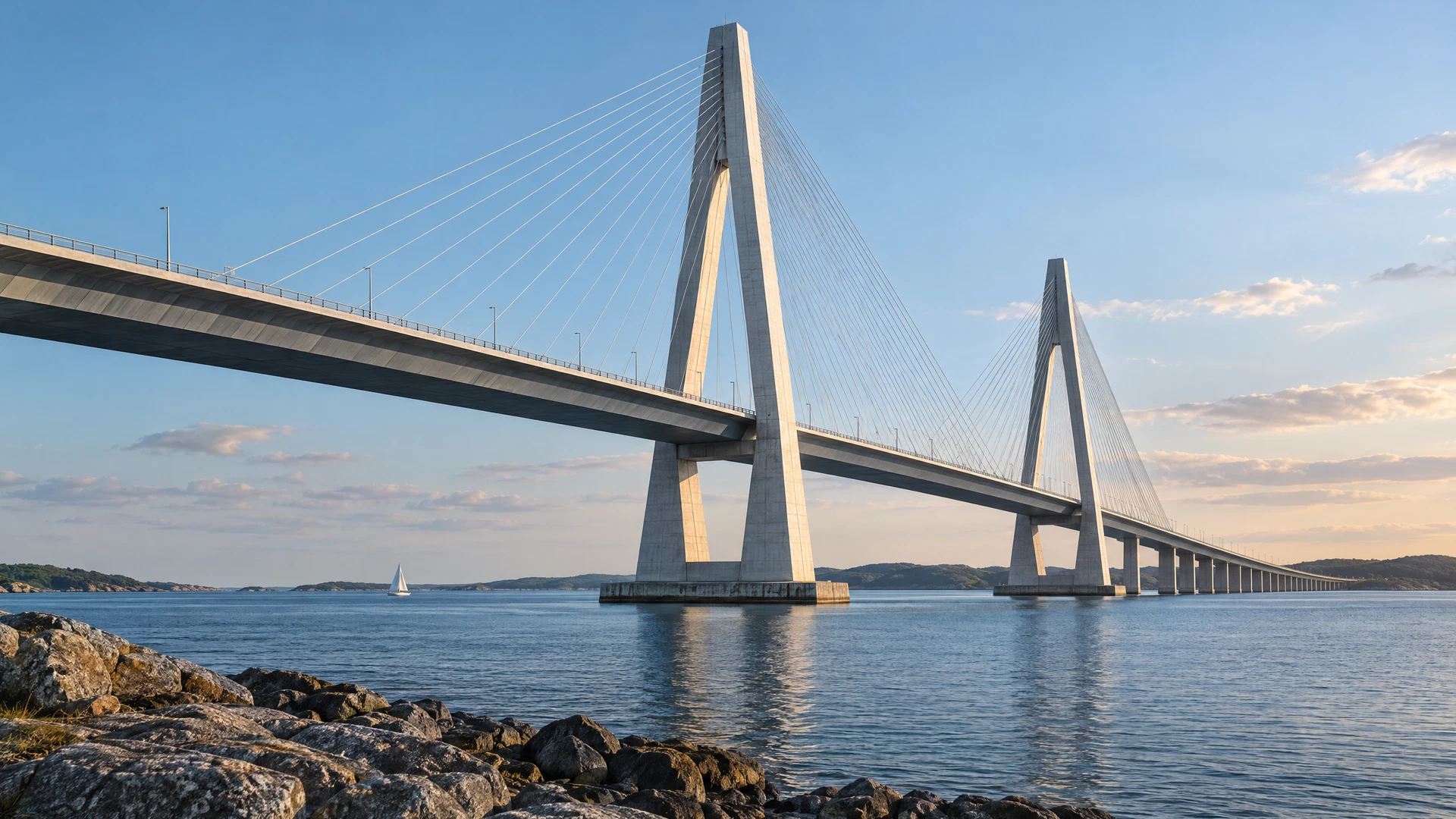
Start with the deck and trace how a load reaches the ground. Suspension and cable-stayed bridges may share a slender outline, but they organise their supporting forces differently.
Structures & Design · Editor’s pick
A bridge’s outline is never just an aesthetic choice. Follow its load path to understand how cables, towers and foundations work together.
Architecture
Coastal engineering
Materials & care
Visuals are original AI-generated illustrations of invented bridges, not photographs of named Danish landmarks.
Structural systems
Start with the deck and trace how a load reaches the ground. Suspension and cable-stayed bridges may share a slender outline, but they organise their supporting forces differently.
A useful way to look at a bridge is to ask what supports each part. The deck carries its own weight and the people or vehicles using it. Girders, cables or arches then transfer those forces to piers, towers, abutments and, ultimately, foundations. Shape becomes easier to understand when it is connected to that sequence.
In a suspension bridge, hangers support the deck from main cables that pass over towers and are secured at their ends. In a cable-stayed bridge, inclined cables connect the deck directly to pylons. These are broad descriptions, not design rules: real structures need a full engineering analysis that includes stiffness, movement and changing loads.
Coastal engineering
Open water gives wind room to act on a bridge. A coastal crossing must be considered as a moving system, with deck shape and structural stiffness working alongside operational precautions.
Wind can push a deck sideways and influence how it twists or vibrates. A slim profile that looks elegant from shore is therefore also an aerodynamic question. Engineers assess the interaction between airflow and structural behaviour rather than assuming that extra weight alone solves the problem.
On a Danish strait, weather also matters to the people using a crossing. A bridge’s design and an operator’s traffic restrictions serve different purposes. This demonstration site does not report current wind conditions or access rules; always consult the relevant operator before travelling.
Architecture & public space
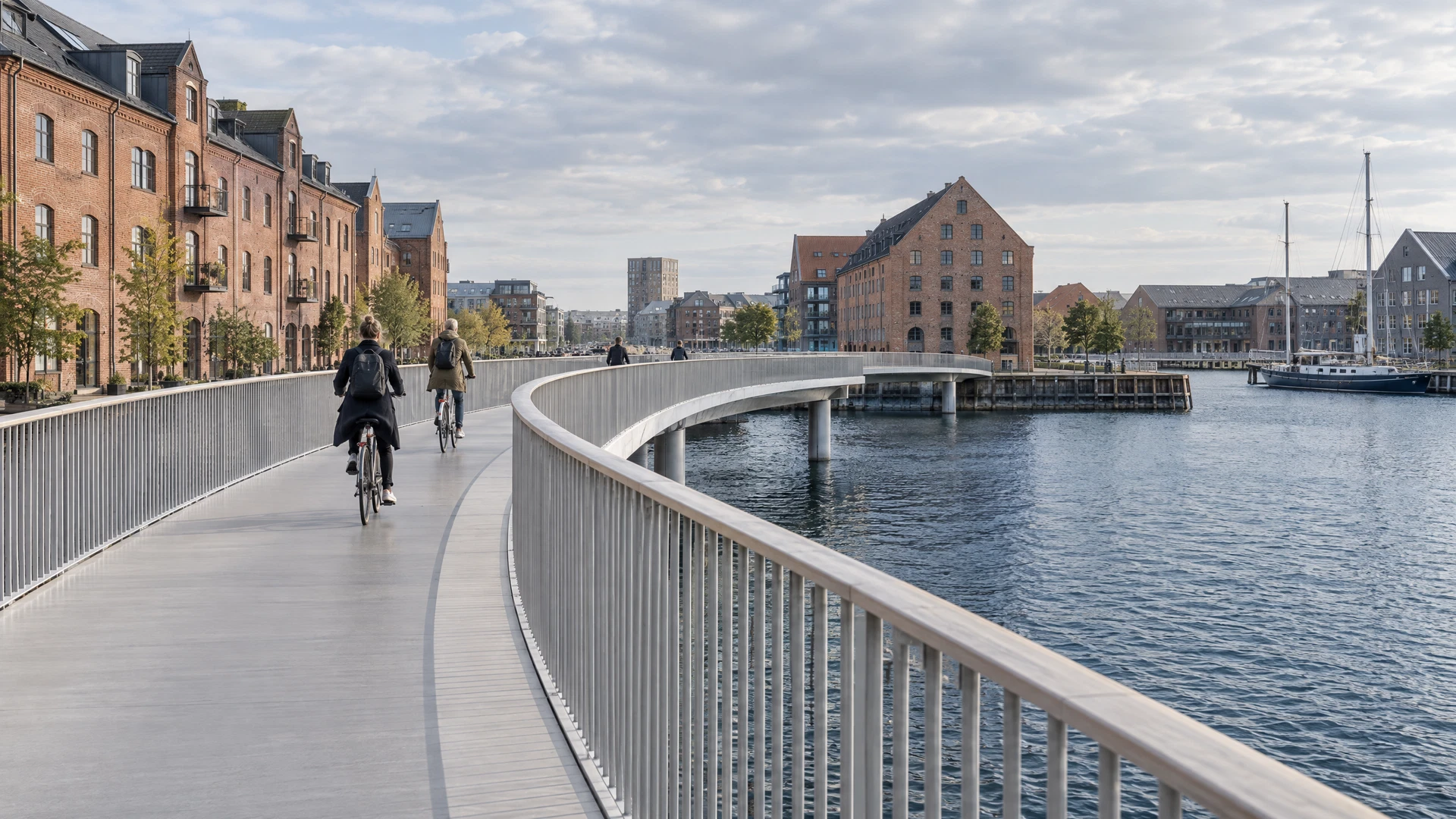
For a person walking or cycling, a bridge is a place as well as a route. Approach gradients, sightlines and the meeting of deck and waterfront shape whether a crossing feels intuitive and welcoming.
A harbour bridge begins before the first span. Its approaches need to make sense within streets, cycle routes and waterside paths. Clear views can help users anticipate one another, while the alignment of a deck can make a route readable without relying on a forest of signs.
Danish urban cycling provides a useful lens for these questions, but a welcoming appearance is not proof of accessibility. Widths, gradients, surfaces, guarding and separation of users need project-specific professional assessment. Our invented harbour image illustrates an atmosphere, not a compliant construction detail.
Materials & maintenance
A coastal bridge lives in a demanding environment. Drainage, protective systems and access for inspection deserve as much attention as the dramatic outline visible from the shore.
Moisture and salt can create conditions that encourage corrosion. The response is not a single material choice but a connected approach to detailing, protection, inspection and maintenance. Water needs a deliberate route away from vulnerable joints rather than places where it can remain unnoticed.
Bearings and expansion joints also allow parts of a bridge to move as temperature and loading change. These less visible components can influence both maintenance needs and the experience of a crossing. The drawing is a conceptual illustration only; it does not specify a bearing type, load capacity or installation method.
Landscape & connections
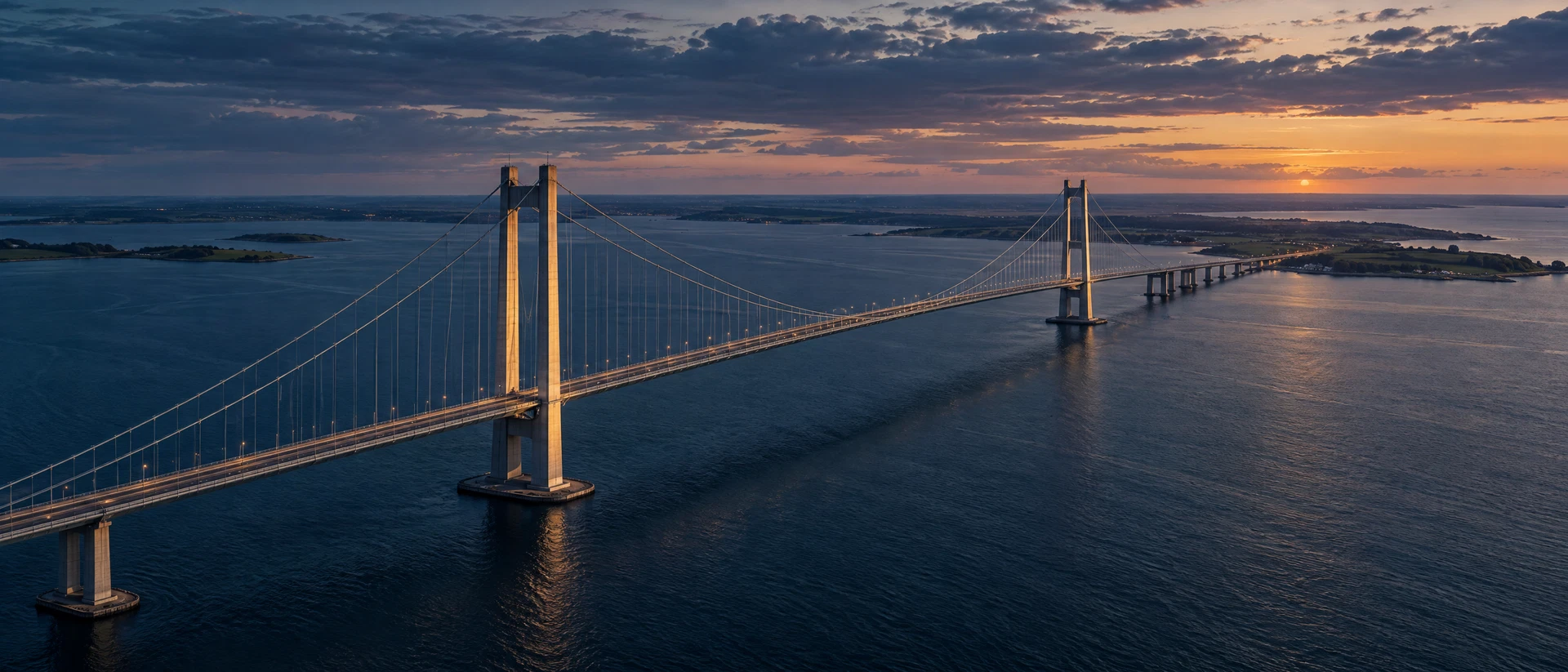
A fixed link does not have to use one structural system from shore to shore. The Storebælt connection between Zealand and Funen combines bridges and a tunnel, a reminder that geography shapes infrastructure.
When water separates regions, the design question is larger than an individual span. Shipping channels, shore conditions and the requirements of road and rail all influence the overall route. A high crossing in one place may sit alongside lower approach spans or a tunnel elsewhere.
Storebælt offers a real Danish example of a link made up of two bridges and a tunnel. Our image is not a depiction of that connection, and this page is not a visitor guide. The educational point is that an infrastructure project can be understood as a sequence of responses to different conditions.
Further reading: Sund & Bælt’s official Storebælt overview
01 / The structure
Load paths, cable systems and the logic that gives a span its shape.
Explore structures02 / The experience
Human-scale crossings and their relationship with the city.
Explore design03 / The detail
Steel, concrete and the everyday work of keeping a bridge useful.
Explore materials04 / The setting
Water, weather and the geography that shapes a connection.
Explore connections